AI Era (1): Your Business Model is Already Obsolete
The AI era makes traditional business models obsolete, like machines replaced blacksmiths. To survive, you can't just add AI; you must rebuild your thinking around delivering outcomes, not tools, and embrace radical speed.

Imagine you are a master blacksmith at the turn of the 20th century. You have spent a lifetime learning your craft — you know the exact colour of the coal at the right heat, the precise rhythm of the hammer, the angle of the anvil. You are proud, and rightly so.
Then one day, a loud, smoky machine rolls into the village square. It produces a perfect horseshoe in a few minutes — stronger, cheaper, and more uniform than anything you can forge in an hour.
Your first instinct is not to learn how to run the machine. It is to dismiss it. "It has no soul," you mutter. But the market does not buy souls. It buys horseshoes.
That is exactly where business stands today. The machine is Generative AI. The horseshoe is any repetitive cognitive task. The blacksmiths who refuse to adapt do not just lose customers — they become a footnote in history.
To survive in 2026, you cannot simply add AI to your workflow. You must rebuild your entire way of thinking about business.
This article — based on a interview with Young Zhao, co-founder and CEO of OpusClip inc. — breaks down what that actually means — in plain terms — across five areas: how businesses are structured, how you choose what to build, how products work, how projects run, and how you lead yourself.
Part 1: How Business Structure Is Changing
From "here's a tool" to "here's the result"
For the past twenty years, the digital economy ran on a simple formula: SaaS (Software as a Service). A company built a tool, rented it to you, and you used your own skill and time to get value from it. Adobe does not design a beautiful poster for you — it gives you Photoshop so you can do it yourself. The assumption was always that the human would do the actual work.
That assumption is now collapsing. We are moving from Software as a Service to Service as Software. The difference is fundamental.
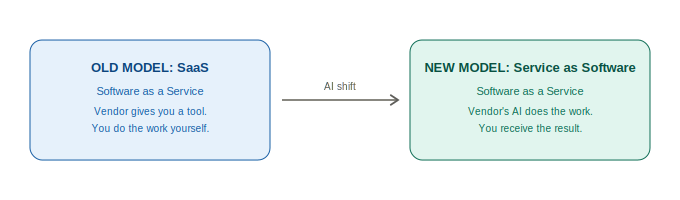
Figure 1: The fundamental shift from tool-rental to outcome-delivery
The new customer does not want a better hammer. They want the shelf already installed. They do not want a video editor — they want the finished clip, ready to post. The product owns the entire job, from start to finish.
Think of a tool like Opus Clip. It did not build a better video-editing tool for creators. It built a tool that replaces the creator's editing work entirely. You give it a long video. It gives you back the viral clips. It does not assist your workflow. It is your workflow.
Key insight: If your business model relies on a human assembling the results of three different AI tools, you are a middleman — and middlemen are the first to be automated away.
The new architecture demands that you identify a painful job that needs doing, then build a digital employee — not a digital tool — to do it. The upside? Massive scale and the ability to charge for outcomes, not subscriptions. The downside? You own the result. A failure is not a bug. It is a broken promise.
Part 2: How to Choose What to Build
Stop chasing big markets. Find boring, painful problems.
Traditional business analysis looked for large markets and projected growth curves. You hunted for "blue oceans" and tried to measure the total addressable market. In 2026, that kind of macro-analysis is a luxury you cannot afford.
Here's why: AI commoditises ideas at terrifying speed. If a market looks attractive to you today, it looked attractive to a thousand other people six months ago. By the time you launch, the space may already be saturated — or worse, absorbed into a feature built directly into ChatGPT or Google.
The new rule: if the problem sounds exciting, run away. Exciting problems attract giants. Boring problems attract builders.
The new analysis is relentlessly micro. Call it the "boring test." If the problem sounds cool — AI-generated art, AI-assisted novel writing — avoid it. The big players (OpenAI, Google, Meta) will absorb those features, or the market will flood with thin copycat apps.
Instead, become an archaeologist of monotony. You are looking for dull, dusty, repetitive tasks that power the real economy.
Example: say you want to build something for the restaurant industry. Old thinking would look at "restaurant management software." New thinking looks at "dim sum restaurants in mid-sized cities." Why? Because inside that hyper-specific niche, there is a genuinely painful job: managing the inventory of dozens of perishable dumpling ingredients on a handwritten notepad because the 60-year-old owner does not trust computers. That is your entry point.
➞ Spend your first weeks watching, not building
➞ Observe the manual, painful task being done in real life
➞ Quantify the time wasted, the frustration, and what they currently pay to solve it (often: a person)
➞ Ask: "Is this painful enough that someone would pay me to make it disappear?"
The advantage of this micro-focus is a durable defensive moat. By the time a large player notices there is money in dim sum inventory management, you already own the data, the relationships, and the workflow. A generic AI model does not know that shrimp dumplings sell better on Sunday mornings in the suburbs. You do.
Part 3: How Products Work Differently Now
From user interfaces to director interfaces
If Part 2 tells you what to build, this part is about how it actually works. In the old world, product design was about user experience (UX) — buttons, menus, and making things easy to click. You worried about how many steps a user had to take to accomplish something.
In an AI-native product, design is about something entirely different: the "director experience." You are not designing a screen for a human to manipulate. You are designing a command structure for an AI to execute. The user is no longer a user — they are a director. They do not click. They delegate.
This is most obvious in what are called multi-agent systems. Instead of one AI doing everything, you have a team of specialised AI agents working together:
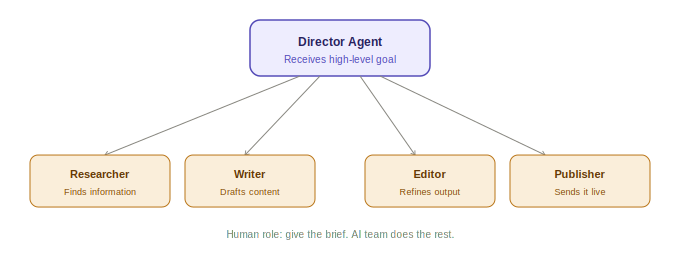
Figure 2: A multi-agent system — one AI orchestrates a team of specialist AIs
The user's interaction is not filling out a form or clicking through menus. It is writing a brief. "Create a 60-second video summary of last quarter's results for LinkedIn." The Director Agent takes that brief and divides the work between the team.
The new product design question is not "how do I make this easy to click?" It is "how do I make the AI team work reliably together, and how do I let a human stay in control without doing all the work?"
This requires a new kind of thinking. You need to map how these digital employees hand work to each other. Where is information stored? How does the Director resolve a conflict if the Writer and the Editor disagree? You need to build in checkpoints, logs, and moments where a human can review and course-correct.
The payoff: you automate entire processes, not just individual tasks. The risk: when five AIs are talking to each other, tracing an error gets much harder. Good product design must account for this from day one.
Part 4: How to Run a Project
Forget six-month plans. Think in 30-day sprints.
Traditional project management ran on deadlines, Gantt charts, and resource allocation. A project might take six months: Discovery, Design, Development, Testing, Launch. AI has compressed that timeline almost beyond recognition.
Why? Because the pace of change means a six-month plan is obsolete before the first sprint ends. A new AI model from OpenAI or Google could launch during your development phase and invalidate your core value proposition overnight. In this environment, controlling the scope is less important than maximising the speed at which you learn.
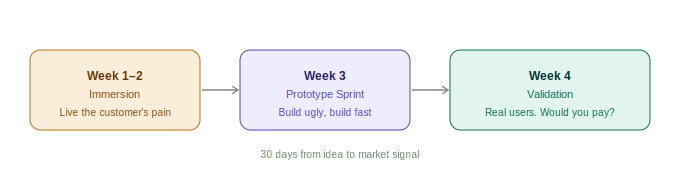
Figure 3: The 30-day build cycle — from idea to real market signal
The new project has three phases, and they blur together:
Phase 1 — Immersion (Weeks 1–2)
You are not in the office. You are in the field, living the customer's pain. The best question to ask: "What is the task you hate most?" This phase ends not with a requirements document, but with a single-sentence hypothesis: "If we build X, restaurant owners will pay Y to stop doing Z."
Phase 2 — Prototype Sprint (Week 3)
This is where old rules get thrown out. You do not hire a five-person engineering team. You sit down with an AI coding assistant (like Cursor) and build a working prototype in 72 hours. It can be fragile. It can break if you look at it wrong. But it demonstrates the main flow. You are not building for scale — you are building for feedback.
Phase 3 — Validation (Week 4)
You take that rough, unfinished prototype to the five restaurant owners you met during immersion. You sit with them. You watch them use it. You ask the terrifying question: "Would you pay for this?" You do this 20 to 30 times. You are not looking for compliments. You are looking for patterns of hesitation and confusion — those tell you what is broken.
The psychological cost is real: showing an unfinished product feels unprofessional. But in a world where being six months late means being out of the game, that discomfort is the price of staying relevant.
Part 5: How to Lead Yourself
In the age of AI, discipline is a competitive advantage.
The deepest change may not be about business at all — it may be about you. In a world where AI handles the tactics, the human must master strategy and, more importantly, self-mastery. The skill that will define the next generation of founders and leaders is not coding. It is discipline.
Think about what a modern founder's day looks like. In a single afternoon, they might move from a deep technical debate about AI inference costs, to a creative discussion about brand tone, to a difficult conversation about team performance. That kind of constant context-switching is cognitively exhausting. The only way to sustain it is with the discipline of a professional athlete. Sleep, nutrition, and focus are not lifestyle choices — they are competitive advantages.
But beyond physical discipline, there is a new cognitive practice emerging: using AI as a thinking partner.
The practice: document everything — meeting notes, personal doubts, strategic decisions — into a private AI system. Over time, it builds a memory of your thinking and becomes a mirror for your blind spots.
With this kind of reflective record, you can ask questions that were previously impossible without a personal coach:
➞ "Over the last three months, when was I most stressed — and what was the common factor?"
➞ "Show me three decisions I made that contradicted the data I had at the time."
➞ "Where have I been consistently wrong in my market assumptions?"
The AI becomes a project manager for your own mind. It reveals your biases without ego or judgment. The upside is a kind of clarity that previously required expensive coaches and therapists. The downside is the vulnerability it demands. Feeding a machine your doubts is an act of trust — it forces an honesty with yourself that is often uncomfortable. But as the pace of the world accelerates, a disciplined mind is the only stable anchor.
Part 6: The One Trap That Will Sink You
Don't build a castle on borrowed land.
Here is a critical warning for 2026: avoid building a "wrapper." A wrapper is a business that is essentially just a fancy interface on top of someone else's AI model. It is a prompt with a login screen. These businesses are castles built on borrowed land.
If your product relies on OpenAI's API, and your core feature could be replicated by a user typing a clever prompt directly into ChatGPT, you do not have a business. You have a feature tutorial. And features get commoditised. The big players will absorb your feature into their base product, and your user base will disappear overnight.
To avoid this, your business needs real defences: end-to-end ownership of the workflow, and proprietary data that nobody else has.
Here is what real defence looks like in practice. If your restaurant application learns the specific inventory patterns of 1,000 dim sum restaurants over 18 months, that dataset is your moat. A generic AI model does not know that shrimp dumplings sell better on Sunday mornings in suburban locations. Your model does. That knowledge is not for sale, and it cannot be replicated by pointing ChatGPT at the problem.
The businesses that will last are not those with the most impressive technology. They are those that own the workflow end-to-end, accumulate the data that no one else can get, and embed themselves so deeply in their customers' daily operations that switching away becomes genuinely painful.
Conclusion: It's all about speed
Let's go back to the blacksmith. The ones who survived the industrial revolution were not those who clung to their hammers. They were the ones who learned to run the machines — applying their knowledge of metallurgy and form to a new medium.
Today, the invitation is the same. The architecture of business, the methods of analysis, and the pace of projects have all changed. Tools are now agents. Outcomes are now the product. The only constant is change itself.
The parable of our time is not about strength or intelligence. It is about adaptability. The question is not whether you are a good project manager — it is whether you can manage a project where half your team is software. The question is not whether you are passionate about building — it is whether you have the discipline to keep building when everything you built last month is suddenly obsolete.
The market of 2026 does not care about your legacy. It only cares about your velocity.


