Public Administration in the Age of AI: Rethinking the Public Machine
Replace OKRs with learning velocity, infer real-world state via AI, and close feedback loops cybernetically for an adaptive public administration.

Introduction: The Unease of Silent Offices
Every day, millions of people walk through the doors of public administration — online or in person — carrying a file, an expectation, and often a sense of apprehension. On the other side, conscientious public servants navigate a labyrinth of procedures, outdated software, and scattered information. The observation is universal: public administration is perceived as slow, complex, and sometimes inhumane. Yet this unease is not the result of malice or collective laziness. It is the symptom of a crisis of cognitive and temporal infrastructure, inherited from a management model designed for a world that no longer exists.
We are living through an era of unprecedented technological upheaval. Generative artificial intelligence tools (such as large language models) are not merely conversational assistants; they are engines for a profound reorganization of how we process information, make decisions, and collaborate. This article proposes to revisit the functioning of public administration through the lens of three innovative frameworks: Delta, a management approach based on learning velocity; real-world state infrastructure, a way of rethinking the digital representation of reality; and cybernetics, the science of steering through feedback. By combining them, we will sketch the contours of a more agile, more transparent, and more human administration.
Part 1: The Diagnosis of Three Systemic Failures
To understand how to transform public administration, we must first establish a precise diagnosis of its current dysfunctions. Three major pitfalls emerge from an analysis of current practices.
1.1 The Illusion of Measurement: The Trap of Quantitative Targets
For decades, public management has drawn inspiration from the private sector by adopting management-by-objectives methods. Among them, OKRs (Objectives and Key Results) have become a standard. The principle is simple: set an ambitious objective (for example, "improve access to social services") and break it down into measurable key results ("increase the number of files processed within 15 days by 20%").
On paper, this seems rational. In practice, it generates well-documented perverse effects. When a public servant is measured on the number of files they close, they have every incentive to close incomplete files or redirect complex cases to other departments. This is known as "gaming" the system. The problem is structural: the feedback delay is too long. We discover that a process is broken three months later, when the indicators are consolidated — but by then, the citizen has already suffered harm. As a critical analysis of OKRs points out, the quarterly cycle is ill-suited to an environment where execution is accelerating. Public administration, meanwhile, faces situations that evolve in real time, but manages them with measurement instruments designed for a stable world.
1.2 The Hidden Cost of State Reconstruction
This is perhaps the most overlooked and most costly scourge. Imagine a citizen submitting a building permit application. The software indicates: "Under review." In reality, however, the surveyor has not yet submitted their report, the heritage architect has issued an unfavorable verbal opinion that has not been recorded, and the mayor is on leave. To ascertain the actual situation, the public servant must spend 45 minutes calling four different departments, consulting three databases, and cross-referencing information. This time spent reconstructing the real state of the file represents an immense hidden cost.
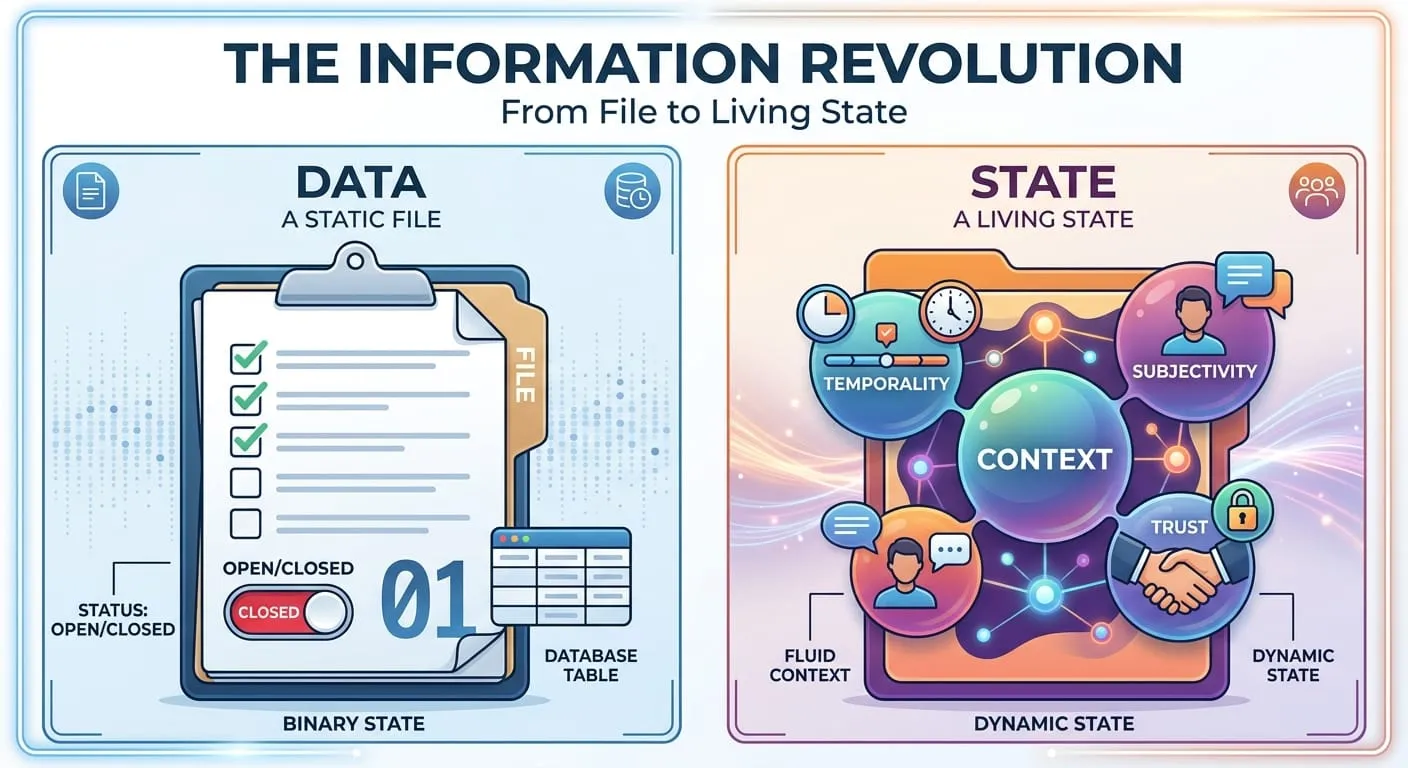
The fundamental error is to confuse data with state. A data point is a recorded value, static and decontextualized (e.g., status = "in progress"). The state, however, is the real condition of an entity at a given moment T, with four properties that classical databases ignore:
- Temporality: the state changes continuously, and the gap with its digital reflection is the primary source of friction.
- Subjectivity: "80% complete" depends on who is judging.
- Trust: first-hand information does not have the same value as a rumor, yet databases treat them identically.
- Relational context: states are intertwined (the fate of one file depends on another).
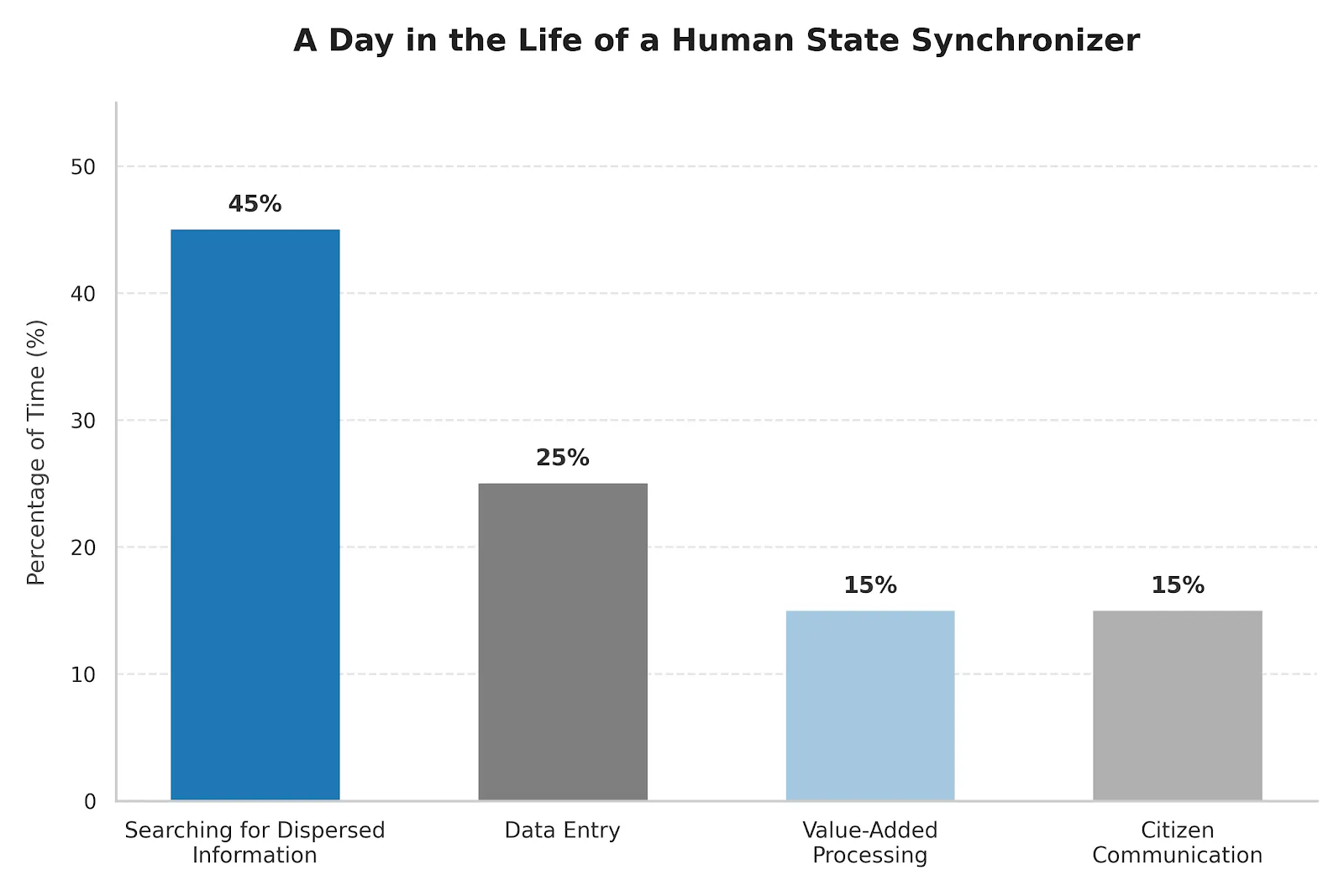
The public servant, in this system, is not a "civil servant" in the noble sense of the term. They are a human state synchronizer. Their primary function is to serve as a translation layer between reality and digital systems. This work is not intrinsically useful; it compensates for missing infrastructure. It is a cost that the administration pays in salaries, time, and service quality.
1.3 Specialization That Breaks the Feedback Loop
Modern public administration is organized in silos: taxation, urban planning, social services, roads, etc. Each department is a world unto itself, with its own rules, culture, and software. This specialization, which was a response to growing complexity, has had a disastrous side effect: it has broken the feedback loop.
In a healthy system, the decision-maker perceives the consequences of their decisions. This is the principle of "tasting one's dish" in cooking. In public administration, the lawyer who drafts a circular never sees the citizen in distress; the front-line officer who hears the anguish does not understand the legal subtleties. The loop is broken. Public policies are designed without field feedback, and frontline staff endure procedures they had no part in defining. This phenomenon is analogous to what happened in software engineering during the age of specialization: the developer no longer touched the production server, and quality suffered as a result.
Part 2: Three Frameworks for a Rebuilding
In response to these three failures, thinkers and practitioners have developed alternative frameworks. They are not miracle solutions, but prisms through which to rethink the organization of work and information.
2.1 Delta: Governing by Learning Velocity
The Delta framework proposes replacing the measurement of position (the result) with the measurement of the derivative: the weekly change in the way one works. The idea is that a person whose methods evolve every week will inevitably end up producing excellent results.
Concretely, each week, the manager and the employee independently assess the state of progress according to four categories:
- Stable: a healthy pace, no intervention needed.
- Breakthrough: a qualitative leap, to be reinforced.
- Blocked: an external (systemic) obstacle to be removed.
- Stalled: growth on pause, requiring support.
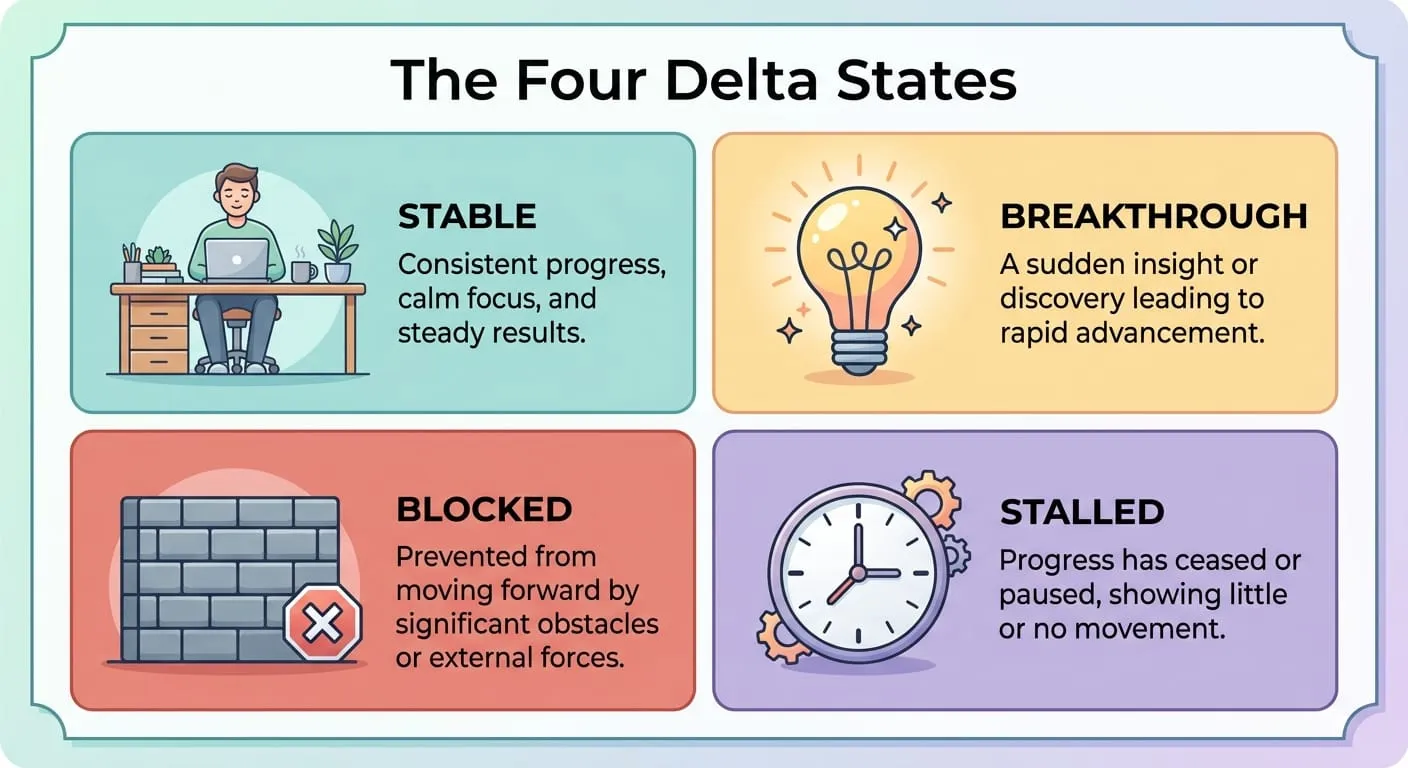
Delta's major innovation is the use of the Johari Window in a double-blind manner. The two assessments are cross-referenced, and the gap between perceptions is the most valuable signal. It reveals blind spots (the manager perceives a talent that the employee is unaware of) or misalignments (the employee feels blocked while the manager does not see it). The ensuing conversation is not a performance review, but a shared diagnosis to accelerate learning.
2.2 Real-World State Infrastructure: Moving Beyond the Data Illusion
The second framework, which we will call real-world state infrastructure, proposes to fundamentally rethink how we represent information. The central idea is that relational databases, with their predefined fields and binary values, are ill-suited to capturing the richness and ambiguity of the real world.
The proposed solution involves using language models (LLMs) as a semantic interpretation layer. These models can read natural language descriptions (emails, memos, handwritten notes) and infer the state with its four dimensions: temporality, subjectivity, trust, and relational context.
The fundamental unit of this new infrastructure is neither the database row nor the document, but the state claim: a dated assertion, linked to evidence, revisable and contestable. This makes it possible to escape the false dilemma between semantic richness (unusable by machines) and structural simplicity (too poor to describe reality).
2.3 Cybernetics: Steering Through Feedback
Finally, cybernetics, the science of system steering, offers a framework for conceiving administration as a self-regulating system. A cybernetic system maintains a target state through a feedback loop:
- A setpoint (the reference, e.g., "maximum processing time of 10 days").
- Sensors (indicators that measure the deviation).
- A comparator (which calculates the gap between reality and the target).
- An actuator (which corrects the course).
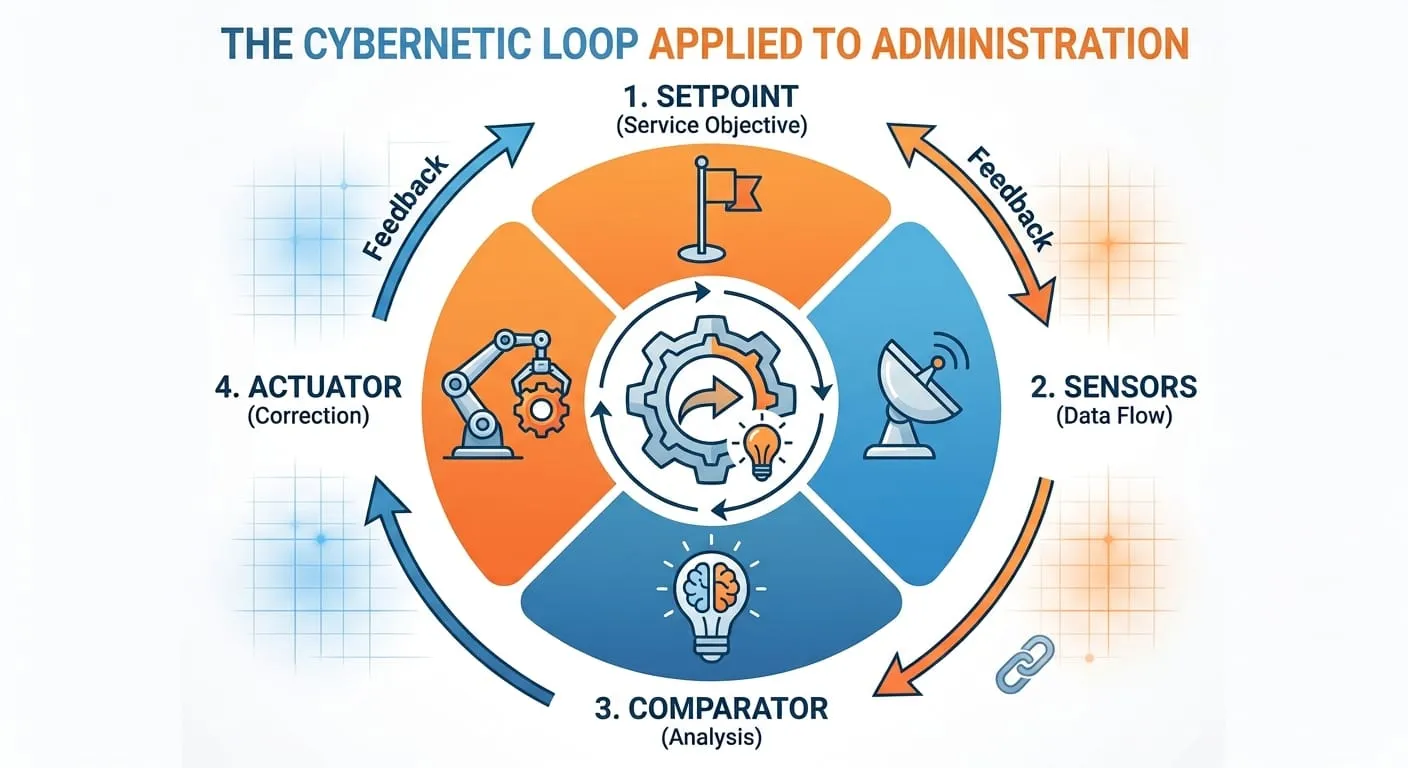
The contribution of LLMs is that they make the actuator intelligent. Instead of applying predefined rules, the AI can interpret the context and choose appropriate corrective strategies. For example, if processing times increase, the AI can automatically reallocate simple cases to automated processing, while redirecting complex cases to human experts.
Part 3: Administration Reinvented
Let us now apply these three frameworks to public administration. We will see how they combine to create a more agile, more transparent, and more human system.
3.1 From OKR to Delta Direction
The first transformation consists of replacing quantitative objectives with Directions. A Direction is a compass heading, accompanied by a comprehensive Narrative: the why, the available data, the levers of action. Results can be metrics (quantified) or milestones (verifiable), depending on the maturity of the subject. This avoids forced quantification.
Take the example of a public health service. Instead of the OKR "increase the number of consultations by 15%", the Direction would be: "Reduce patient anxiety in the care pathway." The Narrative would explain why this is important, what the causes of anxiety are, and what the levers of action are (simplification of forms, reduction of waiting times, better information).
Monitoring is done weekly, not on the number of consultations, but on the team's learning velocity: has it identified new blockages? Has it tested solutions? Has it learned something new about patient needs? The Johari Window is used to detect perception gaps between field staff and managers, and to trigger targeted conversations.
3.2 AI as Real-Time State Infrastructure
The second transformation is the most technical, but also the most promising. It involves deploying an artificial intelligence layer that continuously ingests all information flows: emails, notes, phone logs, opinions from external departments. This AI infers the real state of each file, with its four dimensions.
Let's return to the building permit example. The AI automatically reads the surveyor's email ("I couldn't get there because of the weather"), the architect's verbal opinion ("I am unfavorable, but I will formalize it tomorrow"), and the mayor's absence (via the shared calendar). It synthesizes all this into a state claim: "File X: state = Blocked (cause: surveyor unavailable, unfavorable opinion imminent). Confidence: high. Next recommended action: follow up with the surveyor and prepare a counter-argument."
The public servant no longer has to reconstruct this information themselves. They consult a dynamic dashboard that gives them a clear and updated view of all their files. They move from the status of synchronizer to that of strategic decision-maker. They no longer waste time searching for information; they receive it, and can focus on what matters: making the right decision, taking all nuances into account.
3.3 The Cybernetic Pipeline and the Legislative Double Diamond
The third transformation concerns the design of public policies and processes. Inspired by the Double Diamond in design, it unfolds in two phases:
- A divergence phase: maximum information is collected — feedback, data. The AI can analyze thousands of complaints, satisfaction surveys, and citizen letters to identify the real problems.
- A convergence phase: the central problem is defined, priorities are set, and a solution is designed.
The solution is then formalized in a file that could be called the Constitution (inspired by the AGENTS.MD concept in software engineering). This file contains the value proposition, legal constraints, ethical limits, data model, and key decisions. It is written in a way that is directly interpretable by an AI.
The system then operates in a cybernetic loop:
- The setpoint is the service promise (e.g., "every housing assistance application will be processed within 15 days").
- The sensors are real-time indicators (deadlines, response quality, user satisfaction).
- The comparator is the AI, which continuously measures the gap between reality and the target.
- The actuator is the AI coupled with the information system, which can reallocate resources, change priorities, or alert managers.
The public manager is no longer a controller of task execution. They become a cybernetician who monitors the regulator and intervenes only when the AI detects an anomaly not foreseen by the Constitution. They design the pipeline, but they do not operate it on a daily basis.
Part 4: The Ultimate Obstacle and the Way Forward
This picture is enticing, but it encounters a major obstacle, which is not technical but political and structural.
4.1 The Scarcity of the Generalist Cybernetician
Public administration, like the private sector, is organized around specialization. Career grids, hiring criteria, and training programs are designed to produce experts in a narrow field. Yet the new system requires a person capable of embracing the whole picture: understanding the profession, designing the pipeline, defining the Constitution, and interpreting the signals from the cybernetic loop.
This person is structurally scarce. Specialization, which was the response to complexity, is precisely what prevents the formation of such profiles. The cook who never tastes their dishes will never become a good cook. Likewise, the official who has never worked in the field will not be able to design a system that solves real problems.
4.2 Transparency as Threat and Opportunity
The second obstacle is transparency. A system that makes visible in real time performance gaps, hierarchical blind spots, and bottlenecks is a system that exposes dysfunctions. This can be perceived as a threat by those who derive their power from opacity.
But it is also an opportunity. Transparency, if managed well, can become a lever for trust and continuous improvement. It allows a shift from a culture of blame (which looks for culprits) to a culture of learning (which looks for solutions).
4.3 The Way Forward
The transformation of public administration will not happen overnight, but through a series of local experiments and gradual changes. Here are some concrete avenues:
- Start with a pilot service, preferably one in direct contact with citizens, where frictions are most visible.
- Train a small team in cybernetics and pipeline design, ensuring it includes people with field experience.
- Deploy the real-world state infrastructure using LLMs to ingest and synthesize information, starting with a limited scope.
- Replace OKRs with Directions and institute the weekly double-blind assessment ritual (Johari Window).
- Iterate: adjust the Constitution, refine the sensors, improve the algorithms.
Conclusion: Administration as a Living Organism
Public administration is not a machine for processing files. It is a living organism, composed of human beings who interact with other human beings, in a social and political context that is constantly evolving. The tools we have described — Delta, real-world state infrastructure, cybernetics — are not ends in themselves. They are means of making this organism more self-aware, more responsive, and more adaptive.
Artificial intelligence is not here to replace public servants. It is here to free them from paperwork, state reconstruction, and repetitive tasks, so that they can devote themselves to what gives public service its value: listening, judgment, empathy, and the ability to innovate in the face of unforeseen situations.
The real challenge is not technological; it is cultural and political. It consists of accepting to change our ways of thinking, our habits, and our power structures. But if we rise to this challenge, we can build an administration that is no longer perceived as an obstacle, but as a lever for social progress.
Examples of Administrative Authorization Procedures
To illustrate the concepts discussed, here are three common types of administrative procedures and how the proposed frameworks would transform them:
Example 1: Building Permit Application
Current Process |
Transformed Process (with Delta + State Infrastructure + Cybernetics) |
|---|---|
The applicant submits a file. The system records it as "received." The file passes through multiple departments (urban planning, heritage, environment, fire safety). Each department updates its status independently, but these updates are not synchronized. The applicant waits weeks without knowing the real status. The public servant spends hours calling each department to reconstruct the file's actual state. |
The AI ingests all inputs (emails, internal notes, calendars) in real time. It infers the state: "Blocked — awaiting surveyor report, heritage architect unfavorable." The dashboard shows this instantly. The Direction is "reduce uncertainty for applicants." Weekly Delta assessments reveal that the heritage department is a recurring blockage point. The cybernetic loop triggers an alert: the setpoint (maximum 30 days) is at risk. The AI proposes reallocating resources or simplifying the heritage review for low-impact projects. |
Example 2: Business License Application
Current Process |
Transformed Process (with Delta + State Infrastructure + Cybernetics) |
|---|---|
The entrepreneur submits an application. It must be reviewed by taxation, social security, labor inspectorate, and municipal police. Each department has its own timeline and format. The entrepreneur must follow up manually. The administration has no real-time view of the overall progress. |
The AI creates a unified state claim for each application, aggregating inputs from all departments. It identifies dependencies (e.g., "tax clearance required before labor inspection"). The Direction is "reduce time-to-market for new businesses." Weekly Delta assessments measure the team's learning velocity in removing bottlenecks. The cybernetic loop continuously compares actual processing times against the setpoint and suggests corrective actions. |
Example 3: Environmental Permit for an Industrial Facility
Current Process |
Transformed Process (with Delta + State Infrastructure + Cybernetics) |
|---|---|
The application requires a complex environmental impact assessment, public consultation, and reviews by multiple expert bodies. The process can take years. Information is scattered across different systems and paper files. Decisions are often made without a clear view of the cumulative evidence. |
The AI ingests all expert reports, public comments, and monitoring data. It infers the state with confidence levels: "Under review — public consultation completed, expert opinion on water quality pending (medium confidence)." The Double Diamond is used to design the permit process: divergence (collect all concerns from stakeholders) then convergence (define the core environmental standards). The Constitution (AGENTS.MD) encodes the legal and ethical constraints. The cybernetic loop monitors the process and alerts if deviations occur. |
Summary Tables
Table 1: The Three Failures of Current Public Administration
Failure |
Description |
Consequence |
|---|---|---|
The Illusion of Measurement |
Quarterly OKRs are ill-suited, incentivizing "gaming" |
Decisions based on indicators disconnected from reality |
The Cost of Reconstruction |
The servant spends time piecing together scattered information |
Waste of time, burnout, degraded service quality |
The Broken Feedback Loop |
Specialization in silos, no field feedback |
Public policies designed without ground-level knowledge |
Table 2: The Three Frameworks for Rebuilding
Framework |
Principle |
Application to Administration |
|---|---|---|
Delta |
Measure learning velocity, not position |
Replace OKRs with Directions; weekly double-blind assessment |
Real-World State Infrastructure |
Represent state with 4 dimensions (time, subject, trust, context) |
Use AI to infer the real state of files continuously |
Cybernetics |
Steer through feedback |
Design self-regulated pipelines with setpoint, sensors, and AI actuator |
References and Key Authorities
- Delta Framework: Inspired by critiques of OKRs and management-by-objectives, proposing a learning-centered approach with short feedback cycles. The concept of learning velocity — the ability to cycle rapidly between hypothesis, experiment, and adaptation — is central to this framework.
- Real-World State Infrastructure: Draws on work on the cost of information and semantics, showing how LLMs can resolve the trade-off between richness and structuration. The notion of state claims as the fundamental unit of representation is a key contribution.
- Cybernetics: Rooted in the work of Norbert Wiener, whose 1948 book Cybernetics: Or Control and Communication in the Animal and the Machine established the science of feedback and control. Wiener observed that purposeful behavior in animals could be modeled as feedback-driven error correction.
- Johari Window: Developed in 1955 by psychologists Joseph Luft and Harry Ingham, this model of interpersonal awareness distinguishes four areas: open, blind, hidden, and unknown. It highlights the role of feedback and disclosure in improving self-awareness and communication.
- Double Diamond: Created by the British Design Council in 2005, this process model structures design work into two diamonds: the first focuses on understanding the problem (Discover and Define), the second on creating the solution (Develop and Deliver). It emphasizes divergent thinking (exploring broadly) followed by convergent thinking (narrowing to a decision).
- Software Engineering Evolution: The analysis of specialization and feedback loops in software engineering draws on the historical evolution of the field, from the "heroic era" to model-driven approaches.
These sources, though developed in different contexts (startups, software engineering, design), converge on a single idea: in a complex and changing world, the ability to learn, adapt, and close the feedback loop is the decisive competitive advantage — whether one is a company, an administration, or an entire society.


